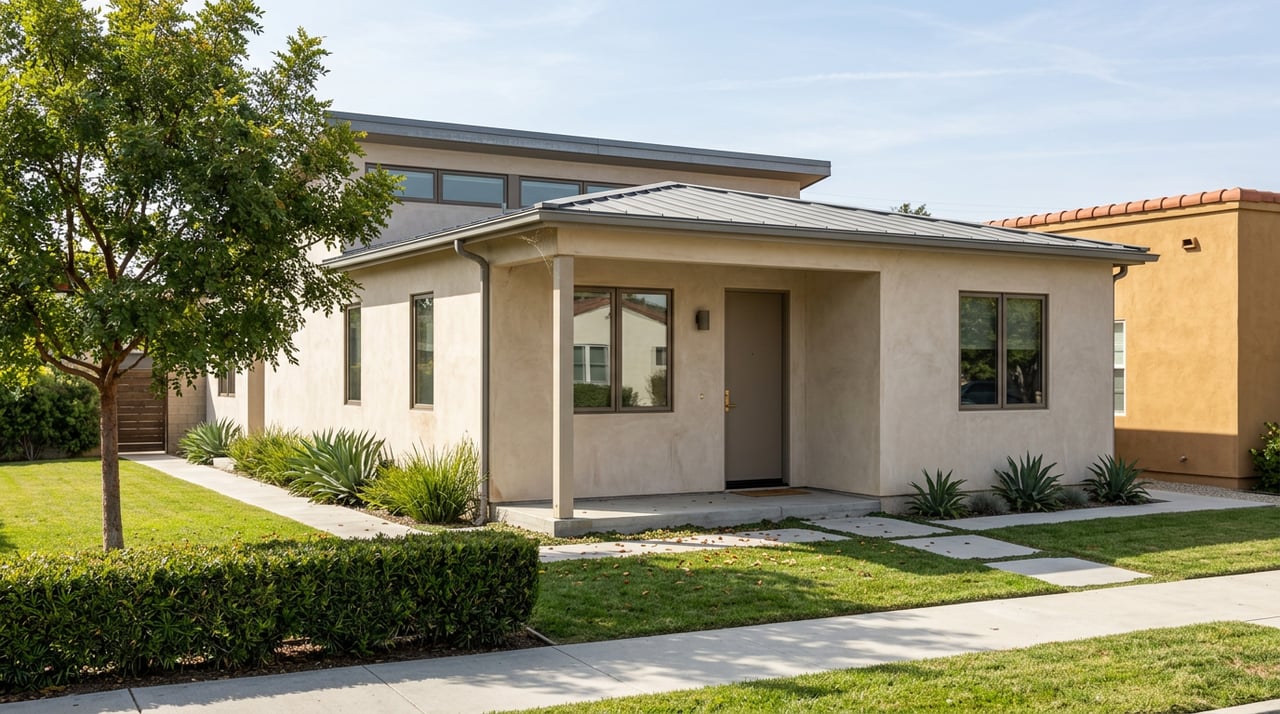
An investor underwriting a duplex near Cal Poly this month is probably running the same spreadsheet an investor would have run in 2019. Enrollment climbs, campus housing lags behind it, the overflow lands in the neighborhoods around campus, and rent follows. That assumption has held for decades in San Luis Obispo. It just stopped being reliable, and the timing could not be more specific: the semester that started this fall is the first one where Cal Poly requires every sophomore to live on campus for two years.
That single policy change, layered onto a billion-dollar campus construction push already underway, is quietly rewriting who competes for rental housing near the university and who doesn't. The city's median price won't show you this. It's happening one zoning line away from where that number gets calculated.
The Assumption Underneath the Offer
The logic that's driven near-campus investment in San Luis Obispo for years is simple and, until recently, correct: Cal Poly can't house everyone who wants to attend, so students spill into the surrounding blocks, and property owners who bought early in that corridor collect rent from a tenant pool that never really shrinks. It's the reason the Foothill corridor near campus has functioned as its own submarket, with older single-family homes and small multifamily buildings converted into long-running student rentals passed between investors rather than sold to owner-occupants.
The problem with that logic is that it assumes the university's housing capacity is fixed. It isn't. Cal Poly has been closing that gap for two decades, and the pace just accelerated.
Twenty Years of a Trend Nobody Priced Into the Offer
Here's the number that should reset how an investor reads this market. Over the last 20 years, Cal Poly added 5,250 beds to its on-campus housing inventory while total enrollment grew by 3,990 students, according to the university's own student affairs office. Beds outpaced enrollment growth. Read plainly, that means the university has been quietly shrinking its dependence on the off-campus rental market for years, even as the city's population of Cal Poly students grew in absolute terms. The corridor didn't feel it because the shift was gradual and enrollment growth still generated headline demand. It's about to feel it, because the next phase isn't gradual.
What Changed This Semester
Cal Poly launched a 10-year, $1 billion Future Housing Plan in the summer of 2024, its largest housing investment in university history, built around modular construction that lets the school deliver new residence halls faster than conventional building allows. The plan adds roughly 4,100 new beds across nine buildings, with the first phase, about 1,348 beds, opening across fall 2026 and fall 2027, and subsequent phases arriving nearly every year after that through 2030, per the CSU Board of Trustees approval announcement.
At the same time, the university now requires all second-year students to live on campus, a policy that took effect this fall. Mike McCormick, Cal Poly's vice president of facilities management and development, told the San Luis Obispo City Council last fall that the policy means no underclassmen will live in the surrounding community absent a special exemption, and said plainly that "this will pull a lot of students out of the community and out of the neighborhoods," adding that the university expects it "to have a big effect on the behavior actually," according to reporting from Mustang News. Courtney Kienow, the university's director of community relations and economic development, made the underlying trend explicit at that same meeting: "We have less students living off campus now than we did 20 years ago."
That's not a projection. That's a description of what already happened, about to compound.
Where the New Supply Is Actually Landing
The near-campus rental corridor isn't the only place absorbing change. New construction south of downtown is pulling a different buyer entirely, and the two markets are starting to diverge in ways worth mapping directly.
| Submarket | What's being built or bought | Entry pricing | Who it's built for |
|---|---|---|---|
| Foothill corridor (near-campus rentals) | Existing single-family and small multifamily stock, largely owner-held investment property | Varies by property, no new construction | Long-term investors, historically student tenants |
| Righetti Ranch (Orcutt area, south SLO) | New single-family homes and live/work units, approved with a required low-income set-aside | From roughly $699,900 | Working professionals, some income-qualified buyers |
| Avila Ranch, Islay and Estero neighborhoods (south of downtown) | New single-family homes across five architectural styles, with designated workforce and moderate-income homesites built into the plan | Islay from roughly $849,990, Estero from roughly $979,990 | Families and move-up buyers, plus income-qualified buyers through the city's workforce housing program |
The contrast matters because it shows two different demand pools solving two different problems. The Foothill corridor was built around a tenant who is about to become scarcer by policy. Righetti Ranch and Avila Ranch were built around an owner-occupant, faculty member, or remote professional who was never competing for that rental stock in the first place. Betting on near-campus rental appreciation and betting on south-SLO new construction are no longer the same bet dressed in different price points. They're exposed to opposite forces.
The Council's Own Disagreement Is the Tell
What makes this more than a simple story of falling near-campus demand is that Cal Poly is racing to grow enrollment at the same time it's racing to house more of that growth itself. The university is targeting 25,000 total students by 2030, up from roughly 23,000 today, a deliberate move tied to California State University system priorities. Whether the new beds actually outpace that growth is genuinely contested, not settled.
Councilmember Emily Francis called the data encouraging, saying she was "excited to see that beds are going to outstrip enrollment growth," and noted the shift from where projections stood two years earlier. Councilmember Michelle Shoresman pushed back on the optimism in the same meeting, saying there's "a healthy sense of cynicism that eventually the number of students on campus will grow enough that we won't have made a dent in the housing issues in the community."
Both are reading the same graph. The disagreement is the most honest signal available right now about how confident anyone should be in a five-year rental projection for property near campus. An investor who assumes the sophomore mandate simply and permanently drains the corridor is ignoring the enrollment target. An investor who assumes enrollment growth simply refills whatever the mandate empties is ignoring 20 years of evidence that beds have outpaced enrollment before.
What the Median Price Still Won't Tell You
None of this shows up in the topline number. San Luis Obispo's median sale price ran $979,000 over the three months ending July 2026, up 2.6% from the same period the year before, with price per square foot at $680, up 5.8% year over year. Those figures describe a city where roughly six in ten households rent rather than own and where the median resident skews young, a reflection of Cal Poly's student population sitting inside a city of modest overall size. That mix means citywide renter and age figures describe the student population more than they describe the neighborhoods where people are actually buying homes. An investor or family buyer reading only the city-level number is averaging together a shrinking student-rental submarket and a growing owner-occupant new-construction submarket, and getting a figure that describes neither one accurately.
If You're Underwriting a Purchase Near Campus Now
The practical takeaway isn't that near-campus property is a bad investment. It's that the underwriting needs a longer and more specific timeline than it used to. The new beds arrive in phases through 2030, not all at once, and the sophomore mandate's effect on any specific block near campus will depend on how quickly that block's existing tenant base turns over. A property with tenants locked into current leases feels this differently than one coming up for re-lease this year. Meanwhile, the workforce and moderate-income set-asides built into Righetti Ranch and Avila Ranch mean some of that new-construction supply won't behave like open-market inventory at all, which changes how a buyer should think about resale comparables in those communities.
This is exactly the kind of local mechanism that a citywide report or a portal search filter won't surface. It takes knowing which council meetings this was debated in and which corridor is which.
FAQ
Does this affect Righetti Ranch or Avila Ranch buyers the same way it affects Foothill corridor investors? Not directly. Those communities were built for owner-occupants and workforce-qualified buyers, not student tenants, so the sophomore mandate's effect on rental demand doesn't touch them the same way. Their pricing and absorption are tied more to new-construction supply and workforce-housing eligibility than to campus housing policy.
When will the effect on near-campus rents actually show up? Given the phased delivery of Cal Poly's new beds through 2030 and leases that don't all turn over at once, expect this to show up gradually on individual properties rather than as a single market-wide shift, with the pace tied to how each phase of construction and each lease renewal lines up.
If you're weighing a near-campus rental purchase, a move-up home in one of San Luis Obispo's new-construction communities, or a 1031 exchange into the Central Coast, it's worth running the numbers with someone who's tracking these policy shifts alongside the comps. Jordan Jackson can walk through what this means for your specific property and timeline. Book a Consultation to get started.